Platelet-Rich Plasma — Principles & Practice
What PRP is, the growth factors it concentrates, and where it is used across dermatology and wider medicine.
.jpeg)
Two treatments, one weekend. Platelet-Rich Plasma injectables and IV infusion therapy — taught face-to-face across two full days, theory and supervised practical on each.
Each gets a full day — the clinical theory first, then a supervised practical session.
 One full day
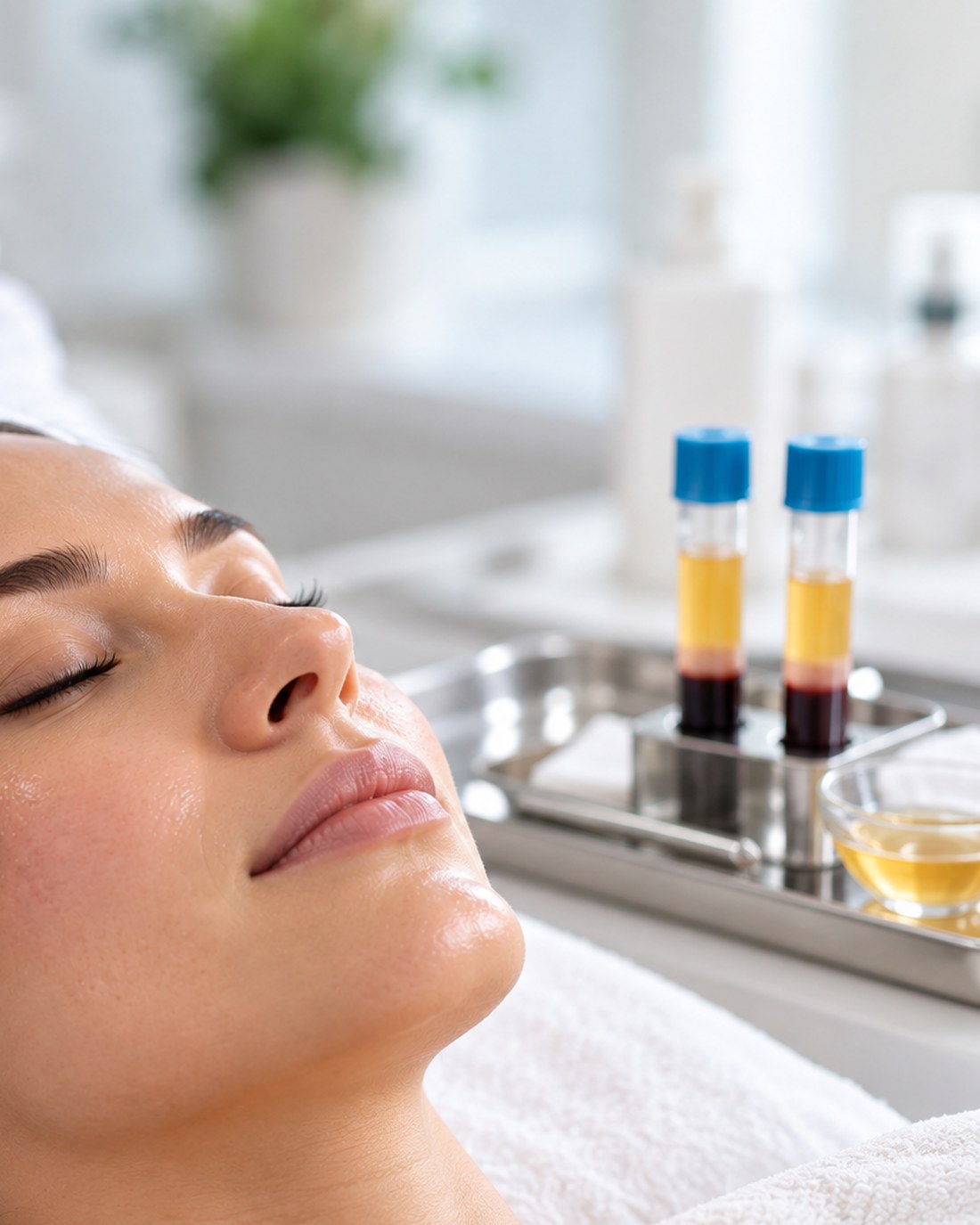
The patient's own blood platelets are harvested to create autologous platelet-rich plasma at a concentration above baseline. Those platelets carry the growth factors — PDGF, TGF-β, VEGF and EGF among them — that drive cell proliferation, angiogenesis and collagen synthesis. Delivered back into tissue, that signal stimulates new cell growth, improving skin texture, tone and complexion and encouraging hair regrowth.
 One full day
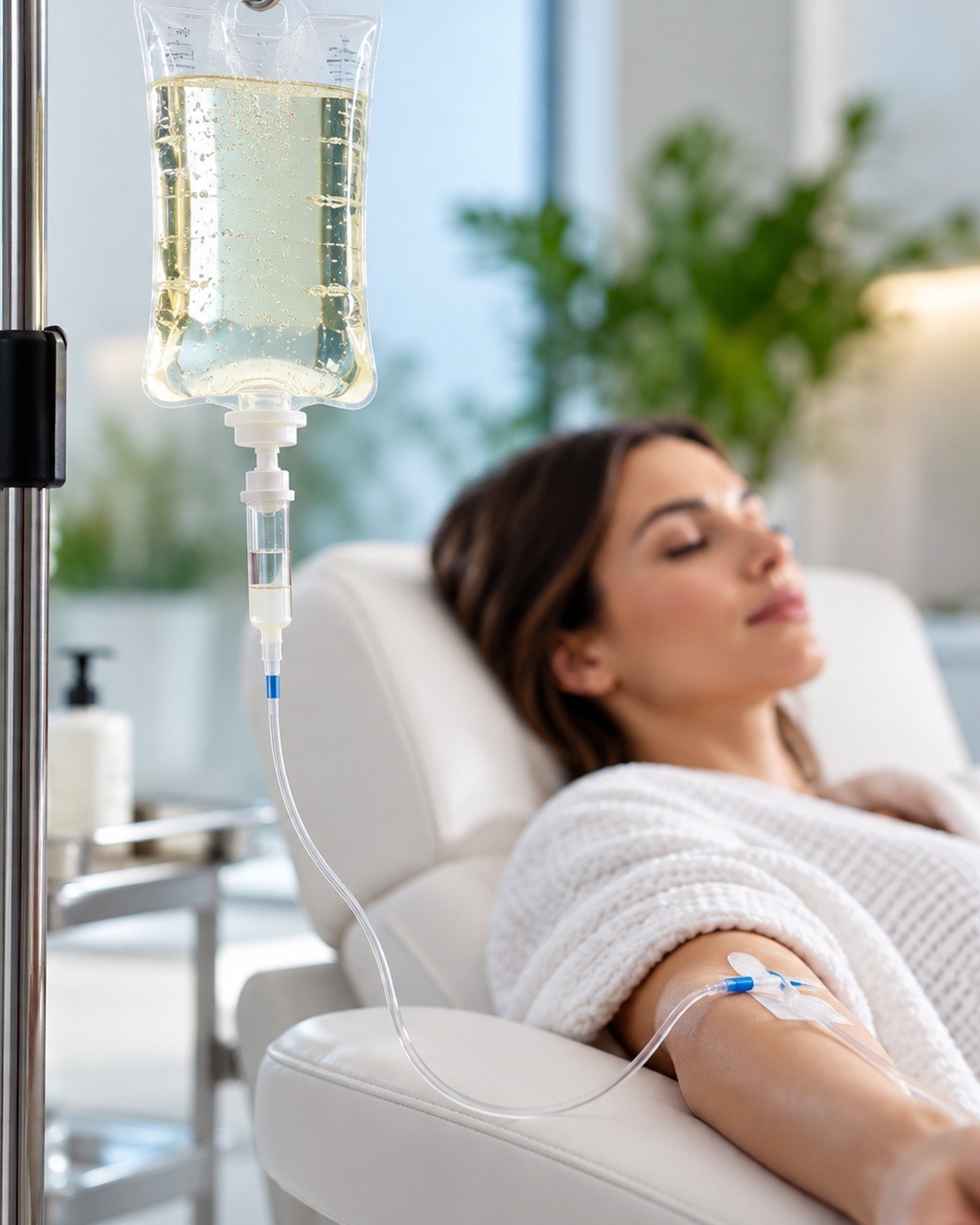
Fluids, medications or nutrients administered directly into the bloodstream through a vein — for hydration and electrolyte balance, for medications that work better given intravenously, and for nutritional support. Because it bypasses the digestive system, absorption is not a limiting factor: onset is rapid, and rate and volume are controlled precisely and adjusted to the patient in front of you.
Both manuals are yours in the student dashboard from the day you enrol — read them before the weekend, keep them as a reference after.
Showing Platelet-Rich Plasma — 7 chapters
What PRP is, the growth factors it concentrates, and where it is used across dermatology and wider medicine.
Skin quality, texture and volume — assessment, indications and realistic outcomes.
Preparation protocols, centrifugation, activation and what actually changes between systems.
Androgenic alopecia, patient selection, injection pattern and treatment intervals.
Avoiding dyspigmentation and scarring — UV protection, patient selection and what to avoid.
Where PRP is combined with other treatments, and how the sessions are sequenced.
Recognising, preventing and managing adverse events across the procedure.
Background, history and where it sits in clinical and wellness settings.
Indications, the settings it is delivered in, and honest limits on the evidence.
Each nutrient, what it does, and how the common preparations differ.
What to assess and test before infusing, and when not to proceed.
Monitoring during the infusion, recognising reactions, and responding to them.
The forms themselves — patient intake, informed consent, information and aftercare.
General dosing, fluids and solutions, and flow-rate calculation.
The standard cocktails and add-ons, and what each is formulated for.
Cannulation refresher — insertion tips, difficult access and troubleshooting.
Implementing the modality in an existing practice — equipment, supplies and setup.
Both manuals are the course's own material, issued through the student dashboard on enrolment.
Both days follow the same shape. One treatment per day, theory before practical, a trainer with you throughout.
Anatomy, indications and contraindications, safety protocols and aseptic technique for the day's treatment — followed by a full step-by-step demonstration of the procedure.
The same shape for the second treatment — the clinical reasoning behind it, patient assessment, and the complications to recognise and manage.
Work through the procedure yourself with a trainer beside you, from preparation and setup through to aftercare and documentation.
Complete the practical for the second treatment, then your competence is signed off.
Certificate awardedWhich treatment runs on which day? Both are always covered across the Saturday and the Sunday, but the running order is set per intake — it depends on trainer and venue scheduling for that weekend. You'll get the confirmed day-by-day timetable with your booking confirmation.
Pick your city and weekend, then continue to our secure checkout. This course runs on its own dates — separate from the beginners programme.
Payments are processed by our PCI-compliant payment partner — card details never touch our servers.
No prior injectables training is needed — this is a standalone course. You will need current AHPRA registration, insurance, and (for Registered Nurses) venepuncture certification. Read the requirements before you book.
This course runs on its own dates, separate from our other programmes. Contact our team and we'll tell you the moment new dates open in your city.
PRP and IV therapy sit under different rules, so eligibility is not the same for both. This is a plain summary of where each profession stands — check it against your own registration and indemnity cover before you book.
| Profession | PRP | IV therapy | What it depends on |
|---|---|---|---|
| Medical Practitioner | Yes | Yes | The clearest position on both. The TGA's exclusion for autologous PRP is written around a registered medical practitioner preparing and using it for a patient under their own clinical care, and doctors can prescribe the Schedule 4 substances an infusion may contain. |
| Nurse Practitioner | Yes | Yes | Holds prescribing rights, so can both order and administer an infusion within their scope. PRP is performed within scope and the AHPRA cosmetic guidelines apply. |
| Dentist | Yes | Conditional | Named alongside medical practitioners in the TGA exclusion, but only for patients under their care and within dental scope — not general facial aesthetics or wellness infusions. |
| Registered Nurse | Conditional | Conditional | Widely performed, but not independently. PRP is done with medical oversight, because the TGA exclusion runs through a medical or dental practitioner. An infusion is administered on a prescriber's order — an RN cannot prescribe Schedule 4. Venepuncture and cannulation competence is assumed for both. |
| Enrolled Nurse | Not usually | Not usually | An EN whose registration carries the medicines notation cannot administer medicines at all. Without the notation, IV medicines still require the NMBA-approved unit (HLTENN040) on top of the Diploma, and scope remains employer- and state-dependent. This is not a realistic independent pathway for either treatment. |
You do not need to have completed our Anti-Wrinkle & Dermal Filler programme first. This course stands on its own — you can take the two in either order, or only this one.
Not sure whether you qualify? Speak to our education advisor before booking and we'll confirm your eligibility.
The same standards that run through every IAHPA programme — small groups, close supervision, and trainers who still practise.
Leave your details and our team will confirm your exact scope and next steps — usually within one business day.
Our team will be in touch shortly to confirm your pathway.
All content on this website — text, course materials, images, videos, logos and page design — is owned by IAHPA and protected under Australian and international copyright law. Unauthorised copying or use may result in legal action.